

Plan a visit
Thank you! Your submission has been received!
Oops! Something went wrong while submitting the form.
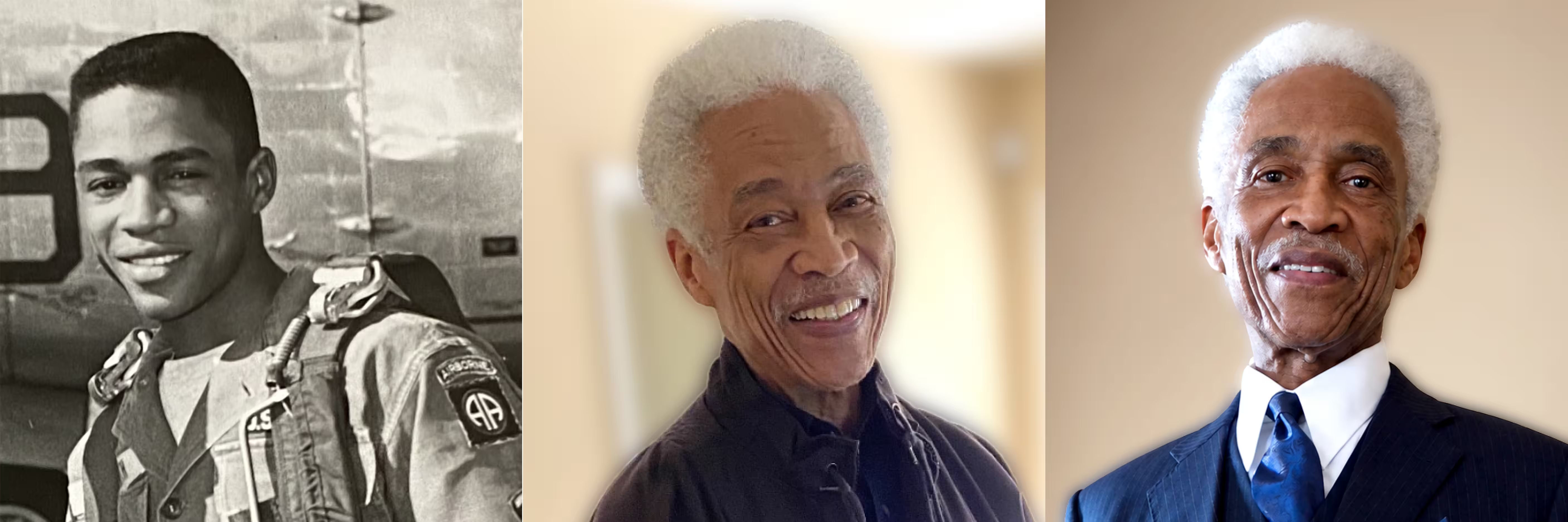
Have you ever met someone who immediately made you feel at home? That was Ezekiel “Zeke” Smith.
Zeke, as he was known to family and friends, was born in Chattanooga, Tennessee, to Edith Harper Smith and Ezekiel L. Smith Sr. He was the first son in a family of four boys and three girls. When Zeke was three years old, his family moved to Springfield, Ohio, and later settled in Toledo.
There was so much about Zeke’s life that was remarkable.
He had a brilliant and creative mind and excelled in school from an early age. While still in grade school, Zeke entered a Ford Motor Company contest and won first place for his original drawing of a Woody station wagon. He graduated second in his high school class and began studying engineering and mathematics at the University of Toledo.
Zeke interrupted his education to answer the call to serve his country. After three years of military service, he completed his service with the rank of Sergeant First Class and earned the National Defense Service Medal. He then returned to finish his education, earning degrees in engineering and mathematics.
But Zeke’s gifts extended far beyond science and mathematics.
He was an artist who expressed himself through beautiful paintings, drawings, and poetry. He was also an inventor. While working at Wright-Patterson Air Force Base near Dayton, Ohio, Zeke developed several devices for the United States Air Force, some of which remained in use for years.
In 1962, Zeke was invited to join the team at NASA during one of the most extraordinary periods in the history of American space exploration. There, he designed and built the first Water Vapor Electrolysis Cell, a device that used electrolysis to separate water vapor into hydrogen and oxygen. The device was used aboard Apollo 11, part of the historic mission that carried Neil Armstrong, Buzz Aldrin, and Michael Collins to the moon in 1969.
Think about that for a moment. The quiet, kind man so many of us knew had contributed his gifts to one of humanity’s greatest technological achievements.
And yet, engineering was only one part of Zeke’s remarkably full life.
He was an accomplished tennis player who enjoyed the sport he loved for more than fifty years. With his beloved wife, Margo Dianne Smith, he shared 63 years of marriage and a life filled with adventure. Together, they enjoyed roller skating, ballroom dancing, motorcycle riding, and so much more.
Zeke was also a gifted entrepreneur and successful businessman. In 1987, he and his business partner and dear friend, Robert Johnson, launched a forensic economics consulting firm that grew into a thriving business and continues today as part of Zeke’s enduring legacy.
Yet as impressive as all of this was, perhaps the most remarkable thing about Zeke was something much simpler:
His kindness.
Kindness was how Zeke loved.
It was how he loved Margo, the ever-present sparkle in his eye, throughout their 63 years of marriage. It was how he loved his family, his friends, his colleagues, and people he had only just met.
What stands out about Zeke is that, despite all he accomplished, he never seemed interested in standing out. His attention was usually directed toward someone else. He supported people. He encouraged them. He celebrated them. He helped others discover and become the best of who they could be.
Kindness was how Zeke loved across race, class, and the many other labels that so easily divide us. He listened with patience. He cared with authenticity. And with his infectious sense of humor, he brought laughter and joy into the lives of those around him.
Yes, no matter who you were, Zeke had a way of making you feel at home in his presence.
If you had asked Zeke where that extraordinary kindness came from, he might first have pointed to his maternal grandmother, Mary Katherine Viola Sewell, whom he loved so dearly. But surely, he also would have pointed to his faith in Jesus Christ.
An encounter with Zeke was often an encounter with the love of Jesus—most often unlabeled, but unmistakably present.
At Zeke’s memorial service, his pastor borrowed the words of 1 Corinthians 13 to describe the love of Jesus that flowed through Zeke’s life. Family, friends, colleagues, and even strangers who encountered him could testify to something remarkably similar:
Zeke was patient and kind.
He was not jealous or boastful or proud or rude.
Zeke did not demand his own way. He was not irritable, and he kept no record of being wronged.
Zeke did not rejoice about injustice but rejoiced whenever the truth won out.
He never gave up. He never lost faith.
Zeke was always hopeful and endured through every circumstance with an abiding faith, hope, and love.
Indeed.
Kindness was how Zeke loved.
.svg)


